

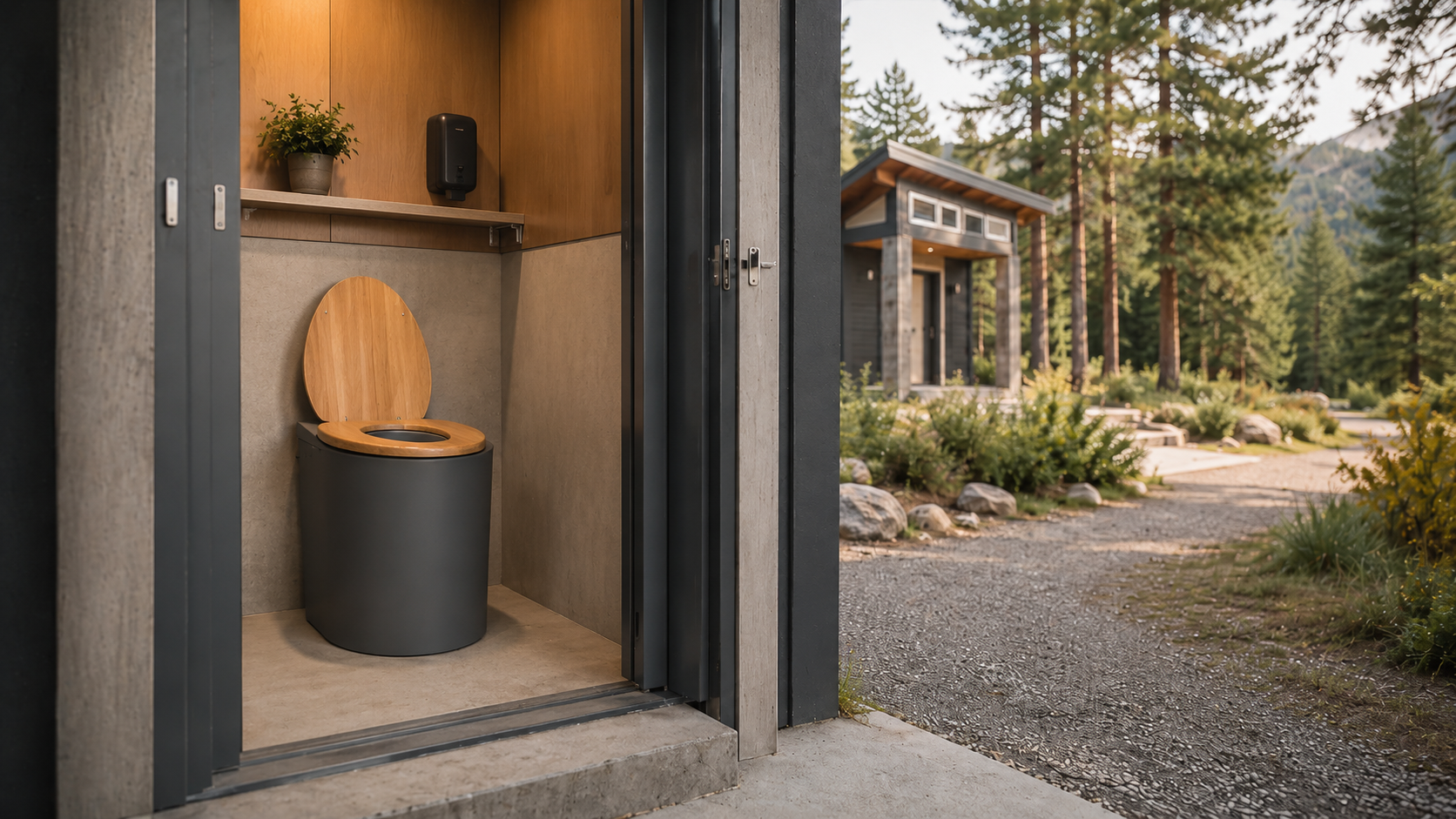
From Vault Toilets to Living Systems: Building the Next Public Bathroom
We are working with partners who are ready to rethink public vault toilets. We are preparing American-made injection-molded designs for launch. We are building for homes, travelers, operators, land managers, and communities that need sanitation to be cleaner, simpler, and more complete.
The Next Public Bathroom Will Not Just Store Waste. It Will Recover Value.
Public bathrooms are essential infrastructure.
They make parks more usable. They make trailheads more welcoming. They support workers, travelers, campers, families, and communities. But many public restrooms in remote or water-limited places still rely on the same basic model: collect waste in a vault, pump it out, haul it away, and repeat.
That model works because it is simple. But it is not the end of the story.
At Virro, we are working with new public-site partners to explore a better path: converting traditional vault toilet sites into cleaner, more sustainable compost toilet systems. The goal is not just to replace one toilet with another. The goal is to rethink what public sanitation can become.
A restroom should not only hide waste.
It should manage it.
It should stabilize it.
And when the conditions are right, it should help return value back to soil.
That is what Virro for Life means.
Why Vault Toilets Became the Default
Vault toilets are common in parks, campgrounds, trailheads, recreation areas, and remote public sites because they do not require flush water or a sewer connection. The National Park Service describes vault toilets as waterless, non-flushing toilets that store waste in a large underground vault container. A typical system includes the underground vault and the above-ground restroom structure. Some vaults can hold thousands of gallons before they need to be emptied.
That makes vault toilets useful in places where plumbing is difficult, expensive, or impossible.
But storing waste is not the same as recovering it.
In many locations, vault toilets depend on pump trucks, road access, service schedules, odor control, and disposal logistics. The more remote the site, the harder that maintenance can become. The U.S. Forest Service has noted that composting toilets are often installed to reduce the need for pumper truck visits and to provide a healthier, safer, more environmentally sound recreational experience.
That is the opening for a better public restroom model.
The Problem Is Not the Toilet. It Is the System Around It.
A vault toilet is a storage system.
A compost toilet is a treatment system.
That difference matters.
In a storage-based model, waste accumulates until it is removed. In a composting model, the restroom begins the treatment process onsite by managing oxygen, moisture, carbon, containment, and time. The National Park Service explains that composting toilets decompose human waste through an aerobic process and include basic components such as a collection chamber, ventilation and exhaust, moisture management, and an access point for removing finished humus.
This is not about making public restrooms complicated.
It is about making them smarter.
A better public toilet system should be clean for the user, practical for the operator, and responsible for the land around it. It should reduce water demand. It should reduce unnecessary hauling where possible. It should separate streams before they become harder to manage. It should support long-term maintenance instead of emergency service calls.
Most importantly, it should be designed for real public use.
Not a concept.
Not a science project.
A working restroom system.
Why Waterless Public Sanitation Matters
Public restrooms use resources, even when they are remote. Flush systems need water. Sewered systems need infrastructure. Vault systems need pumping and hauling. Portable chemical toilets need servicing and chemical treatment.
Waterless sanitation changes the equation.
The EPA says toilets are the largest source of water use inside the average home, accounting for nearly 30% of indoor water consumption. Older toilets can use as much as 6 gallons per flush. While that EPA figure is for homes, the lesson applies anywhere sanitation is scaled: every flush has a water cost, and every water-based system needs infrastructure behind it.
Remote public sites often do not have that luxury.
That is why composting systems can make sense for:
Trailheads
Campgrounds
Parks
Boat launches
Remote work sites
Outdoor event sites
Public lands
Tiny-home communities
Eco-resorts
Seasonal facilities
High-cost septic locations
The best public restroom is not always the one connected to the biggest system. Sometimes it is the one designed to work cleanly and locally.
What a Vault-to-Compost Conversion Can Look Like
A conversion does not have to mean tearing everything out and starting over.
Every site is different, but the basic idea is simple: evaluate the existing restroom structure, usage patterns, access, maintenance schedule, regulations, ventilation, collection needs, and downstream handling plan. Then design a system that can shift the site from storage-only sanitation toward composting and recovery.
That may include:
A waterless compost toilet fixture
Source separation of liquids and solids
Aerobic treatment for solids
Carbon cover material
Ventilation or filtered airflow
Liquid collection or diversion
Operator access for service
A safe material-handling plan
Clear user instructions
A local compliance review
The goal is to create a public restroom that works better for everyone: visitors, land managers, maintenance teams, and the environment.
Virro’s Renew system is already built around this sanitation model. Renew is described as a urine-diverting, waterless compost toilet for places where plumbing is unavailable or undesired. It separates waste at the source, controls odor through natural processes, and supports safe, contained decomposition.
For public sites, that same thinking becomes even more important.
Separation makes maintenance cleaner.
Aeration supports biological activity.
Durable materials make service easier.
Containment protects the site.
Recovery gives the system a reason to exist beyond disposal.
Public Restrooms Should Feel Clean
Sustainability does not matter if people avoid the restroom.
That is why the next generation of public compost toilets has to feel different from the old stereotype. It has to be clean, bright, easy to use, and easy to maintain. It has to be designed like public infrastructure, not like a temporary workaround.
For users, the experience should be simple:
Open the door.
Use the restroom.
Follow one or two clear instructions.
Leave without thinking about the system behind it.
For operators, the experience should be predictable:
Know when service is needed.
Access components easily.
Keep odor controlled.
Avoid overflows.
Protect the site.
Handle material safely.
A truly sustainable restroom is not just low-impact. It is also usable, serviceable, and trusted.
Made in America, Built for the Real World
This is where Virro’s product launch matters.
We are gearing up for the launch of our American-made compost toilets, and the work is happening right now. Molds are being made for our injection-molded designs. That step matters because it moves the product from prototype thinking into repeatable manufacturing.
Injection molding is not just about making a toilet shell.
It is about consistency.
It is about cleanable surfaces.
It is about durability.
It is about designing parts that can be produced, assembled, serviced, and scaled.
For a public restroom system, those details are not small. They are the difference between a good idea and a product that can live in the field.
Virro’s current product language is already pointed in this direction: “Clean. Separated. Recovered.” The Renew is positioned as a waterless sanitation system designed to work with natural processes, not against them.
Now we are building the manufacturing foundation to bring that model into more places.
Homes.
Cabins.
Vans.
Tiny homes.
Public sites.
Remote facilities.
Communities that need better options.
Sustainability Has to Include Maintenance
A restroom is only sustainable if it can actually be maintained.
That is one of the biggest lessons in public sanitation. A system can look good on paper, but if maintenance is too hard, too expensive, too frequent, or too unpleasant, it will fail in the real world.
This is why Virro’s approach is practical first.
We are not interested in creating a restroom that only works in a brochure. We are designing systems around the realities of use: high traffic, seasonal patterns, remote access, limited utilities, operator training, odor control, user mistakes, and long service intervals.
Closed-loop sanitation has to be built with respect for the people who maintain it.
The person cleaning the restroom matters.
The person servicing the chamber matters.
The ranger checking the site matters.
The visitor using it for the first time matters.
A better toilet is not enough.
The system has to work for life around the toilet.
That is Virro for Life.
From Waste Management to Resource Management
The bigger shift is this: public sanitation does not have to be only about waste management.
It can become resource management.
The EPA describes composting as a way to recycle organic materials into compost, a valuable soil amendment. EPA also notes that composting keeps nutrients local, supports a circular economy, and helps shift organic materials from a waste product into a valuable resource.
That is the future we are building toward.
Not every site will close the loop in the same way. Not every facility will have the same regulations, climate, traffic, staffing, or material pathway. But the direction is clear.
Public restrooms can use less water.
They can reduce hauling.
They can separate waste streams.
They can stabilize material.
They can support recovery.
They can become part of a more local, more resilient sanitation model.
A vault toilet stores the problem.
A compost toilet begins the return.
The Future of Public Toilets Is Already Being Built
The next public bathroom will not be defined by a flush handle.
It will be defined by fit.
What fits the site?
What fits the maintenance team?
What fits the watershed?
What fits the budget?
What fits the future?
For some places, conventional sewer or septic will still make sense. For others, the better answer will be waterless, separated, compost-based, and local.
That is where Virro is headed.
We are working with partners who are ready to rethink public vault toilets. We are preparing American-made injection-molded designs for launch. We are building for homes, travelers, operators, land managers, and communities that need sanitation to be cleaner, simpler, and more complete. Learn more how you can become a partner with Virro.
Because the toilet is not the end of the line.
It is the beginning of the system.
Clean. Separated. Recovered.
Built for life.
FAQ
Can a vault toilet be converted into a compost toilet system?
In some cases, yes. A site evaluation is needed first. The existing structure, vault condition, ventilation, usage volume, access, regulations, and maintenance plan all determine whether a conversion is practical.
Why convert a public vault toilet?
A vault toilet stores waste until it is pumped and hauled away. A compost toilet system can begin treating material onsite, reduce reliance on water, and potentially reduce pumping needs when properly designed, permitted, and maintained.
Are compost toilets good for public parks and trailheads?
They can be. Compost toilets are especially useful where water, sewer, septic, or pump-truck access is limited. The system must be matched to visitor volume, climate, operator capacity, and local regulations.
Do public compost toilets smell?
A well-designed compost toilet manages odor through separation, airflow, carbon balance, moisture control, and routine service. Odor problems usually point to a design, maintenance, ventilation, or usage issue.
Are Virro toilets made in America?
Virro is preparing American-made compost toilets for product launch, including injection-molded designs now moving through the mold-making stage.
What does “Virro for Life” mean?
Virro for Life is about building sanitation systems that work in real life: clean for users, practical for operators, durable in the field, and designed around recovery instead of disposal.
Ready to close the loop?
Explore Virro systems for homes, cabins, vehicles, and places beyond the grid.