

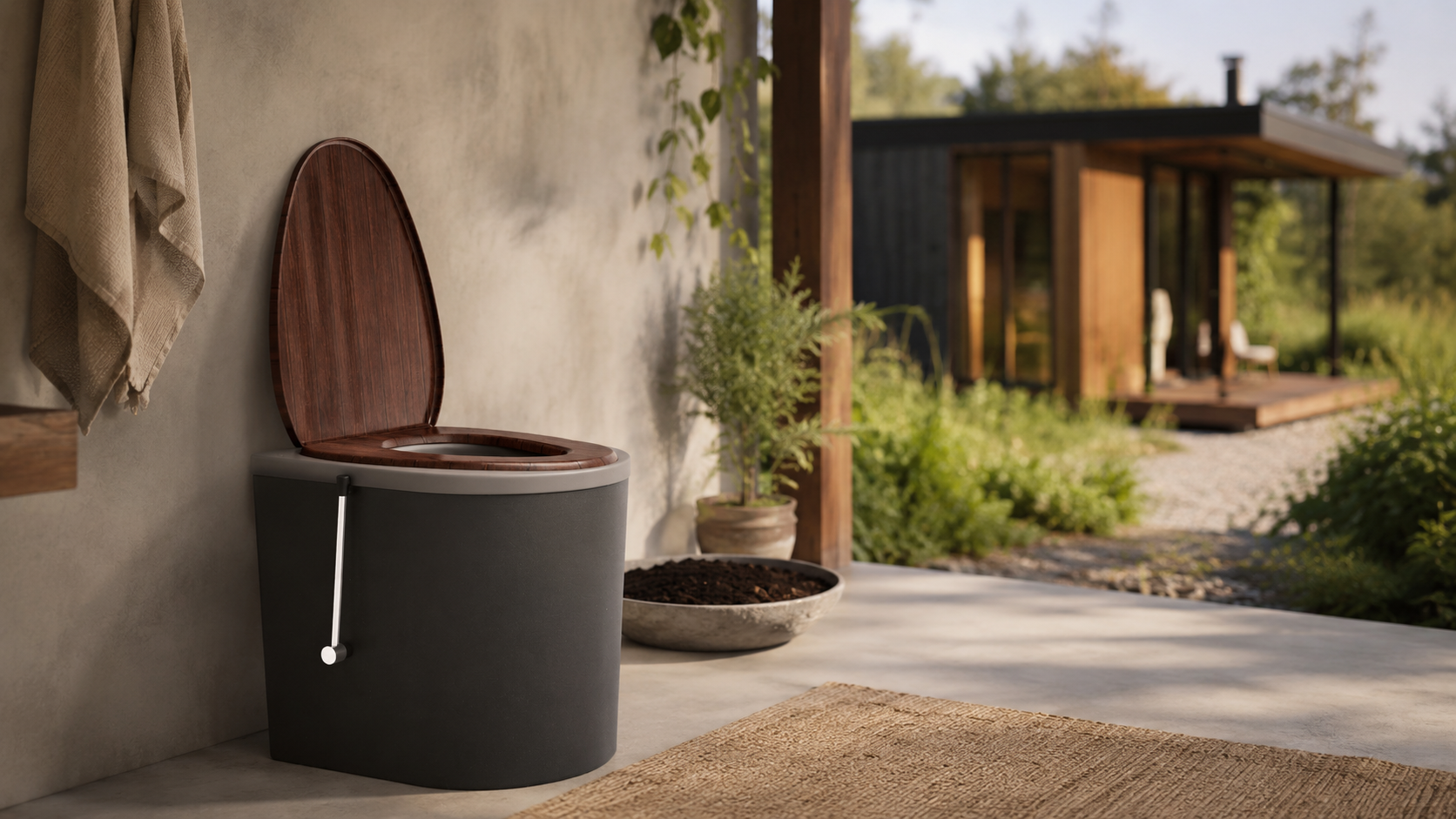
Closing the Loop: The Toilet Is the Start. The Soil Is the Return
A Better Bathroom Starts With a Better Question The old question was: How do we get waste out of sight? The better question is: How do we keep people safe while recovering what still has value? That question changes everything. It changes the toilet from a disposal fixture into the first step of a resource system. It changes waste from a problem to manage into a material to treat carefully. It changes the bathroom from the end of the line into the beginning of a loop.
What Does “Closing the Loop” Mean in Sanitation?
Closing the loop means designing sanitation so waste does not simply disappear downstream. Instead, it is separated, contained, treated, stabilized, and, where allowed, returned to useful cycles.
In simple terms: the toilet is the start. The soil is the return.
For most of modern life, toilets have worked in a straight line. Clean water comes in. Waste goes out. Pipes, tanks, treatment plants, trucks, or leach fields take over from there. That system can work, but it also hides something important: human waste contains water, carbon, nitrogen, phosphorus, potassium, and organic matter.
A closed-loop system asks a better question.
What if sanitation was not only about disposal?
What if it was also about recovery?
Virro’s approach starts with that idea. The Renew compost toilet is designed around separation, waterless operation, contained decomposition, and recovery — a different sanitation model built to work with natural processes, not against them. Virro describes the system simply: “Clean. Separated. Recovered.”
The Problem With “Flush and Forget”
The flush toilet is familiar, but it is not simple. It uses clean water to move waste away from the user. That waste then becomes part of a larger wastewater problem.
According to the EPA, toilets are the main source of water use inside the average home, accounting for nearly 30% of indoor water consumption. Older, inefficient toilets can use as much as 6 gallons per flush.
That does not mean every flush toilet is bad. Modern water-efficient toilets are much better than older fixtures. But the basic model is still linear:
Water in → waste out → treatment somewhere else.
Closed-loop sanitation changes the direction of the conversation. Instead of asking only how to move waste away, it asks how to handle each stream more intelligently.
That starts with separation.
Separation Is the First Step
When liquids and solids are mixed together, the system becomes harder to manage. Moisture rises. Odor risk increases. Useful nutrients become diluted. Treatment becomes more complicated.
When liquids and solids are separated at the source, each stream can be handled in a cleaner, more practical way.
Solid material needs oxygen, carbon cover, time, and the right conditions for composting. Liquid material, especially urine, is nutrient-rich and can be stabilized or treated separately. This is why source separation is such an important part of closed-loop sanitation.
NSF describes composting toilets as systems that use little to no water, generally do not require a municipal sewer or septic connection, and provide an enclosed environment for natural aerobic decomposition.
That word “aerobic” matters. It means oxygen is present. In composting, oxygen helps support the microbes that break down organic material in a more stable, controlled way.
The EPA defines composting as managed, aerobic biological decomposition by microorganisms. It also notes that composting can return nutrients and carbon to soil, improve soil quality, support plant growth, and build resilience in local ecosystems and communities.
Closed-loop sanitation is not about tossing waste into nature. It is about containment, treatment, and responsible recovery.
From Solid Waste to Compost
In a closed-loop system, solid waste is not treated as something to ignore. It is treated as a material that needs the right process.
That process depends on several basics:
Containment keeps material out of direct contact with people, animals, soil, and water before treatment is complete.
Carbon cover helps balance moisture, add structure, and support aerobic conditions.
Airflow helps oxygen reach the composting material.
Time allows biological processes to work.
Safe handling matters at every stage.
Finished compost can support soil health when it is produced, tested, and used appropriately. The EPA notes that compost can improve soil structure, help soil hold water, support beneficial soil organisms, reduce erosion, and slowly release nutrients.
That is the heart of the loop: organic material returns to soil instead of being treated only as waste.
But the language here should stay careful. Not every composting toilet output is instantly “garden-ready.” Rules, treatment time, system design, local regulations, and intended use all matter. A responsible closed-loop system does not skip safety. It builds safety into the process.
Urine Is Not Just Wastewater
Urine is often the overlooked part of sanitation.
In a conventional system, urine is diluted with flush water and mixed with other wastewater. In a separating system, it can be collected as its own stream. That matters because urine contains valuable plant nutrients, especially nitrogen, phosphorus, and potassium.
A 2025 review of closed-loop sanitation systems describes resource recovery from source-separated urine as a circular economy approach where valuable nutrients can be recovered and applied for crop growth and food production. The review also notes that treating urine at the source can reduce nutrient loads on municipal wastewater treatment plants and reduce dependence on mined phosphorus.
This is one of the clearest examples of closing the loop.
A nutrient leaves the body.
A system captures it.
Treatment makes it more stable and usable.
The nutrient can return to agriculture or soil systems where permitted.
Virro’s own Closing the Loop page points to this bigger future: humanure becoming finished compost, urine becoming stabilized fertilizer, and sanitation becoming a pathway to recovery instead of only disposal.
Closed-Loop Does Not Mean DIY Guesswork
Closed-loop sanitation should feel modern, clean, and predictable.
It should not feel like a science project in the bathroom.
That is where design matters. A better system makes the right thing easy. It separates streams before they become messy. It controls odor through airflow and natural process design. It uses durable, cleanable materials. It gives people simple maintenance routines. It keeps the bathroom experience familiar.
Virro’s Renew is designed as a urine-diverting, waterless compost toilet for places where plumbing is unavailable or undesired. It separates waste at the source, supports contained decomposition, and uses aeration to maintain active aerobic composting.
That matters because closed-loop sanitation will only become normal if it feels normal to use.
People should not have to choose between sustainability and comfort. They should not have to choose between off-grid freedom and a clean bathroom. The better path is a system that is simple enough for daily life and thoughtful enough for the planet.
Where Closed-Loop Sanitation Makes Sense
Closed-loop sanitation is not one product for one type of person. It is a different way to design bathrooms for real-world conditions.
It can make sense for:
Off-grid cabins where water access, sewer, or septic installation is limited.
Vans and RVs where space, water, and dump-station access are constant constraints.
Tiny homes and ADUs where conventional infrastructure may be expensive or complicated.
Remote worksites where sanitation needs to be clean, contained, and serviceable.
Water-conscious homes where reducing flush water is part of a bigger conservation plan.
Commercial or community sites where separated streams can be collected, treated, and recovered at a larger scale.
The future of sanitation will not be one system everywhere. Cities, rural homes, mobile spaces, and remote sites have different needs. Closed-loop thinking gives people more options.
The Soil Connection
Soil is not dirt. It is a living system.
Healthy soil holds water, supports plant roots, stores carbon, cycles nutrients, and helps landscapes recover from stress. Compost can support that system by adding organic matter, improving water retention, and slowly releasing nutrients. EPA guidance notes that compost can help conserve water resources, support soil health, reduce nutrient runoff, and build climate resilience.
That is why “closing the loop” is not just a sanitation idea. It is a soil idea. A water idea. A resilience idea.
The bathroom may seem far away from the garden, the farm, or the forest. But in a circular system, they are connected.
The toilet is the start.
The soil is the return.
What Closing the Loop Does Not Mean
Closed-loop sanitation is powerful, but it should not be overclaimed.
It does not mean every user can put toilet compost directly on a vegetable garden.
It does not mean regulations disappear.
It does not mean maintenance is optional.
It does not mean every site can handle material the same way.
It means we stop treating sanitation as a one-way trip.
A responsible closed-loop system still respects public health, local rules, safe handling, treatment time, testing when required, and appropriate end use. The goal is not to be casual with waste. The goal is to be smarter with resources.
That distinction matters.
Virro’s role is not to make sanitation feel risky or fringe. The role is to make recovery feel clean, understandable, and built for real life.
A Better Bathroom Starts With a Better Question
The old question was: How do we get waste out of sight?
The better question is: How do we keep people safe while recovering what still has value?
That question changes everything.
It changes the toilet from a disposal fixture into the first step of a resource system. It changes waste from a problem to manage into a material to treat carefully. It changes the bathroom from the end of the line into the beginning of a loop.
Closing the loop is not about going backward.
It is about designing forward.
A cleaner bathroom.
A simpler system.
Less water wasted.
More nutrients recovered.
More organic matter returned to soil.
That is the future Virro is building toward.
Clean. Separated. Recovered.
FAQ
What is closed-loop sanitation?
Closed-loop sanitation is a system that separates, contains, treats, and recovers human waste streams so they can be handled safely and, where allowed, returned to useful cycles such as composting, soil building, or nutrient recovery.
Is a composting toilet part of closed-loop sanitation?
Yes. A composting toilet can be part of closed-loop sanitation because it keeps waste out of a conventional flush stream and supports contained treatment. The loop is strongest when solids and liquids are separated, stabilized, and managed responsibly.
Can human waste really become compost?
Yes, human waste can be composted under controlled conditions, but it must be handled carefully. Time, temperature, oxygen, moisture, carbon balance, system design, local rules, and intended end use all matter. Not all material from all systems should be used the same way.
Why is urine important for nutrient recovery?
Urine contains plant nutrients, including nitrogen, phosphorus, and potassium. When urine is separated at the source, it can be stabilized or treated separately instead of being diluted into wastewater.
Does closing the loop mean I do not need septic or sewer?
Not necessarily. Local codes decide what is allowed. Even if a composting toilet handles toilet waste, graywater from sinks, showers, laundry, and kitchens may still require an approved system.
Is closed-loop sanitation only for off-grid living?
No. Off-grid cabins, vans, RVs, and remote sites are strong use cases, but closed-loop thinking can also apply to homes, commercial buildings, public sites, and communities looking for more resilient sanitation options.
Ready to close the loop?
Explore Virro systems for homes, cabins, vehicles, and places beyond the grid.