

The Toilet for the Next Generation
By Gaelan Brown, October, 2026 · Virro for Life
“Flush & Forget” conventional toilets are convenient and hygienic. But the “hidden costs” in water use, sewage treatment, land development and lost fertilizer value are becoming more visible.
By my estimates the USA flushes away nearly $3 billion annually in lost fertilizer value, just from human urine, while using more than 2 billion gallons of clean water per day to flush toilets. Approved residential septic systems can cost between $15,000 to over $100,000 and the USA spends more than $100 billion annually running sewage treatment plants.
Meanwhile the cost of fertilizer in the USA has risen up to 50% between 2015 and 2025 and organic certified humanure compost sells for more than $300 per ton in some markets.
These were some of the factoids I shared at my seminars for the 2026 Tri County Home & Garden Show Tiny House Expo, to get people’s attention on the topic of toilets with a different perspective.
Affordable housing is a growing challenge all around the world, even in some of the most affluent and developed regions, such as California. California has responded to this in some interesting ways, especially by encouraging the use of Tiny Houses and Auxiliary Dwelling Units (ADUs).
But even though Tiny Houses and ADUs are a much more affordable option for many people in California, one of the biggest obstacles is the cost and feasibility of sewers and septic systems. You might spend $100,000 to $150,000 for a Tiny House, and then need to spend $50,000 or more on an approved engineered septic system. You might have to spend $20,000 for sewer connections and wait for a year for permit approvals. The cost of conventional sanitation can be a very large percentage of an overall Tiny House project.
A colleague of mine recently told me that there are multiple counties in California in which 20% to 30% of existing residential building lots cannot be developed because sewer or septic systems are not feasible.
At the 2026 Tri-County Home & Garden Tiny House Expo, my daily seminar presentation was essentially the story of my personal quest to do tiny house RV life without relying on sewer systems or dump stations. I tried to give people a comprehensive overview of what I’ve learned over the years by using and researching alternative toilet systems.
I offered my opinion that a primary reason most jurisdictions don’t allow composting toilets as permitted options to sewer and septic systems is because most of the solutions out there don’t quite solve the problem.
What came to me during the talk is a line that sounds like a marketing slogan, but I really meant it. “We’re aiming to invent the toilet for the next generation.” We are aiming to actually solve the problem.
Meet the idea, not the spec sheet
The “Meet Renew” section in my seminar wasn’t a feature parade. It was my introduction to what defines a different category of toilets: ReGen Toilets, where the toilet stops being a disposal appliance and starts being the front door of a resource recovery loop.
We’re aiming to provide a complete solution including urine processing and complete two-stage composting of the humanure solids, specifically to enable US building codes and permit requirements to be updated with a path for composting toilets.
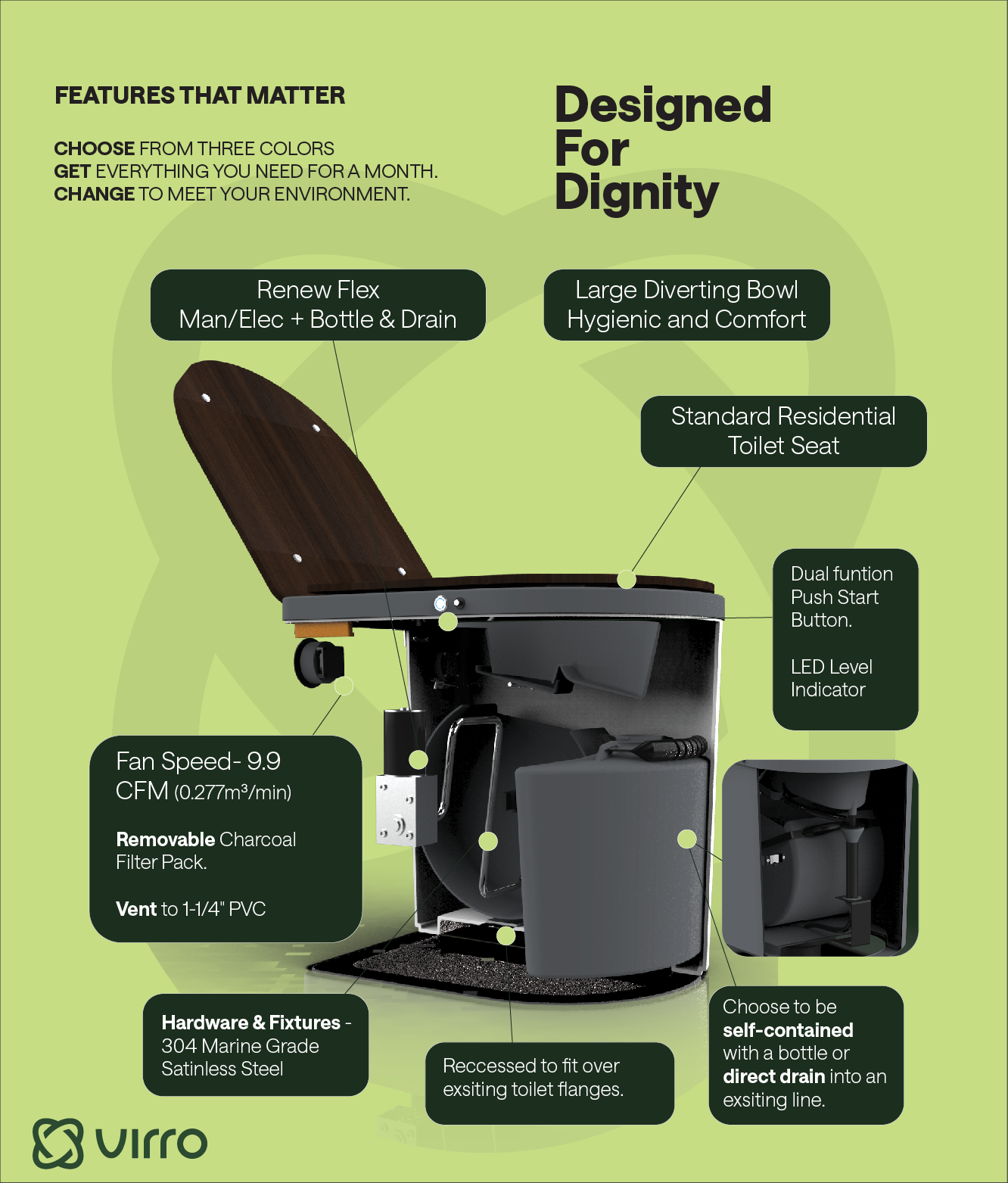
Renew is just the first toolkit in that process. Renew separates liquids and solids at the point of use, keeping them from becoming a single mess. Inside is a real aerobic composting process with active mixing and aeration, and flexible options for direct-draining of urine into existing plumbing or an inner storage container with a full-sensor.
We want to offer a visual style and a user experience that people actually want to live with, and then aim the outputs toward recovery of value instead of expensive waste to dispose of.
That’s the story Virro keeps telling: from flush-and-forget to steward-and-recover.
The next generation doesn’t need a slightly nicer version of the old problem. The next generation needs a bathroom that enables the next generation of human development and growth. The next generation needs a sanitation system that not only conserves resources but also converts waste into value and enables development of affordable housing for everyone.
What “next generation” actually means to us
It means dignity first. A real, comfortable, soft-close toilet seat. A restroom that doesn’t smell like compromise. Flexibility for all types of restrooms and use cases — manual, electric, flex — without turning ownership into engineering homework or maintenance headaches.
For us, “a toilet for the next generation” means the category shifts. Composting toilets stop being a niche apology for off-grid life or RV life, and start being an obvious choice for people who want independence without giving up the comforts of home.
It means the closed loop travels, and the question becomes: what if waste wasn’t the end of the story?
The lines we keep
Designed for dignity. Engineered for the planet. Clean. Separated. Recovered. Renew is our first ReGen step toward the toilet for the next generation.
Ready to close the loop?
Explore Virro systems for homes, cabins, vehicles, and places beyond the grid.