

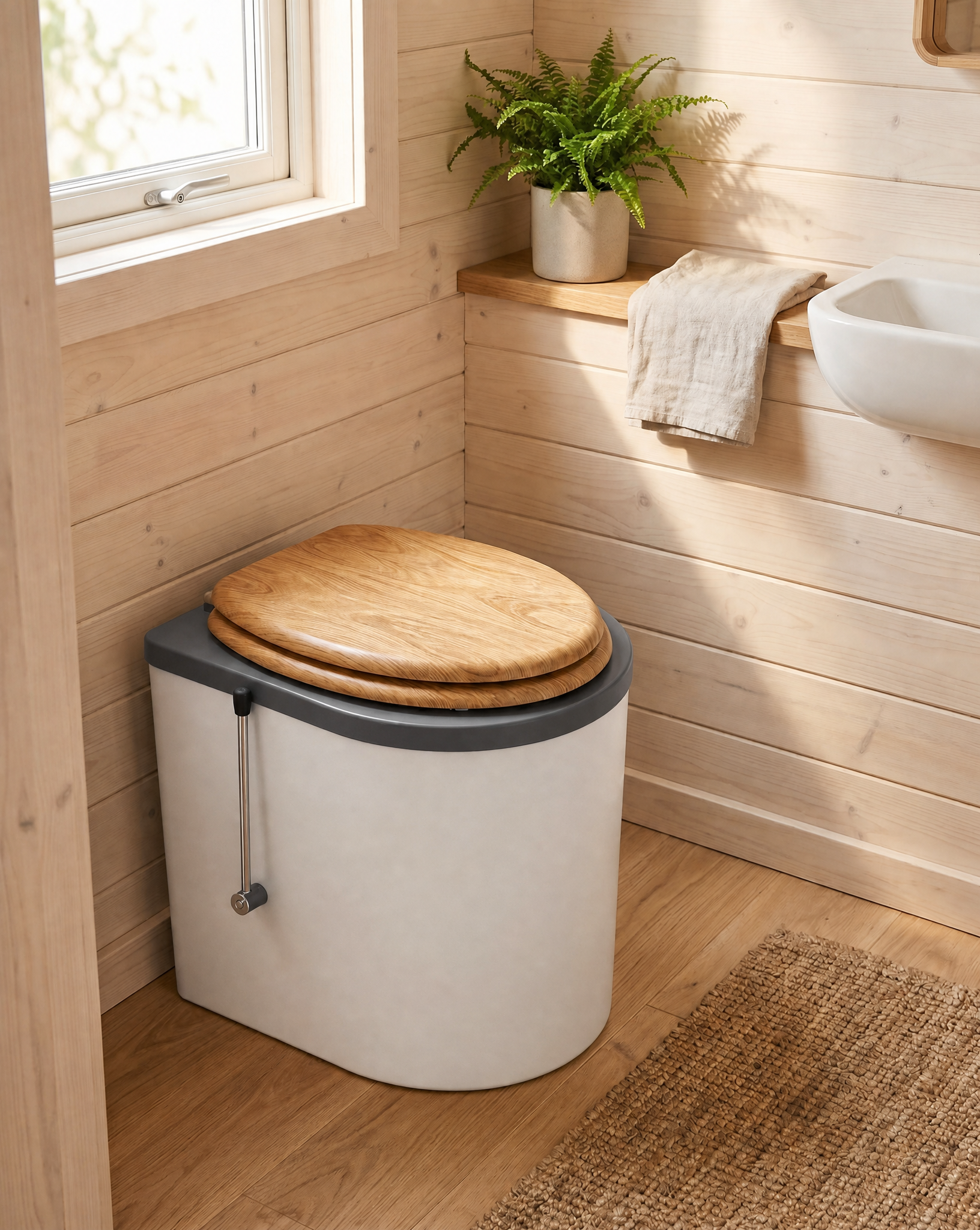
How Does a Composting Toilet Work?
A composting toilet works because it respects a simple biological truth: with the right conditions, nature breaks down organic matter on its own. Separation, oxygen, carbon, and time are not design quirks — they are the core of the system. Every element of a well-designed unit exists to maintain these conditions reliably. If you have been considering the switch, the technology is mature, the maintenance is minimal, and the impact — on water use, on infrastructure dependency, on your footprint — is real.
How Does a Composting Toilet Work?
Most toilets solve waste by moving it somewhere else. A composting toilet takes a different approach. Instead of using drinking water as a transport system, it creates a controlled environment where biology can begin doing the work.
The key is not magic. It is separation, oxygen, carbon, and time. When these four elements are balanced correctly, human waste breaks down into a stable, dry material — safely and without the infrastructure of a sewer system or septic tank.
Here is exactly how the process works, and why each step matters.
What Happens After Use?
A composting toilet separates liquid from solid waste at the point of use. This separation is the first and most important step. Urine, if mixed with solids in volume, creates an anaerobic (oxygen-free) environment — which produces odor and slows or stops decomposition.
Once separated, liquids are diverted away — typically absorbed or evaporated — while solids enter a composting chamber below. In Virro's Renew system, this process is framed simply: separation, carbon cover, composting, and recovery. Each step builds on the last.
After depositing, a small amount of carbon cover material — usually coconut coir, wood chips, or sawdust — is added on top. This begins the biological process immediately.
Why Does Oxygen Matter?
Aerobic decomposition — breakdown in the presence of oxygen — is the foundation of composting. When oxygen is present, aerobic bacteria do the work efficiently and without producing foul gases. When oxygen is absent, anaerobic bacteria take over, and the byproduct is hydrogen sulfide: the source of sewage smell.
A well-designed composting toilet maintains airflow through the chamber at all times. Ventilation serves two purposes: it keeps oxygen available for aerobic bacteria, and it carries moisture-laden air and any trace gases away from the bathroom — out through a vent stack to the exterior.
This is why a properly maintained composting toilet does not smell. The air in the unit is always moving in one direction: down and out.
What Does Carbon Cover Do?
Carbon material does more than simply cover waste. It serves three essential functions:
-
Absorbs excess moisture, keeping the pile at the right humidity for bacterial activity
-
Balances the carbon-to-nitrogen ratio, which drives efficient breakdown
-
Creates air pockets throughout the pile so oxygen can penetrate deeper
The ideal composting environment sits at roughly 25–50% moisture and a carbon-to-nitrogen ratio of around 25:1. Carbon cover material — coconut coir is common because it is clean, sustainable, and highly absorbent — naturally corrects both when added after each use.
Without carbon cover, piles become wet, compacted, and anaerobic. With it, decomposition stays active and the chamber remains manageable between empties.
How Long Does Composting Take?
Inside the active chamber — the portion being used day-to-day — decomposition begins immediately but is not complete. The material is in a partially broken-down state during use.
True stabilization happens in a secondary curing phase. After the chamber is emptied or allowed to rest, the material continues to break down over several weeks to months. At the end of this curing period, the output is a dry, soil-like material called humanure or compost — stable, odorless, and rich in organic matter.
The timeline varies depending on temperature, moisture, and how often the toilet is used. Warmer temperatures and lower volumes speed the process. Most residential composting toilets are designed to be emptied every few months for a household of two to four people.
What Composting Toilets Do Not Do
It helps to be direct about limitations, because they shape whether this is the right fit for you.
A composting toilet does not eliminate the need for care. The system requires occasional emptying, periodic addition of cover material, and basic airflow checks. It is an active biological system, not a passive fixture.
It also does not instantly produce garden-ready compost. The output from a residential unit is typically suitable for non-edible plants or further outdoor composting — not direct food garden use in most cases, unless the curing period is extended significantly.
What it does do is remove waste from the water cycle entirely, reduce household water use by up to 30%, and make sanitation possible in places where traditional plumbing cannot reach.
Virro's Renew System
Virro's Renew Manual Compost Toilet is designed around these four principles — separation, carbon, airflow, and time — in a system that is straightforward to install and maintain. No water line. No sewer connection. Designed for tiny homes, cabins, and off-grid living where sustainability is not optional.
Ready to make the switch? Explore the Renew Manual Compost Toilet →
Frequently Asked Questions
Do composting toilets smell?
No — when correctly set up and maintained, a composting toilet should not produce noticeable odor in the bathroom. The ventilation system draws air downward and out, keeping the space neutral. Odor typically only occurs when the carbon balance or airflow is off, both of which are easy to correct.
Do composting toilets need water?
No. Composting toilets require no water to function. This is one of their primary advantages — they eliminate a significant source of household water use and require no connection to plumbing, a septic system, or a sewer. Some models use a very small amount of water for bowl rinsing, but the composting process itself is entirely dry.
Can a composting toilet replace a regular toilet?
Yes, for many households and applications. Composting toilets are a full functional replacement for a flush toilet in cabins, tiny homes, remote properties, and off-grid builds. They handle the same waste load and, with routine maintenance, perform reliably year-round. The main consideration is user comfort with occasional emptying and cover material addition — tasks that take only a few minutes.
What is the best cover material for a composting toilet?
Coconut coir (coir fiber) is widely considered the best option. It is highly absorbent, sustainable, low-odor, and breaks down well within the composting process. Avoid materials that are too wet, too fine, or chemically treated.
How often does a composting toilet need to be emptied?
For a household of two adults, most composting toilets require emptying every one to two months depending on usage and chamber size. Some larger units extend this interval further. The Renew system is designed for straightforward access so emptying is quick and clean.
A composting toilet works because it respects a simple biological truth: with the right conditions, nature breaks down organic matter on its own. Separation, oxygen, carbon, and time are not design quirks — they are the core of the system. Every element of a well-designed unit exists to maintain these conditions reliably.
If you have been considering the switch, the technology is mature, the maintenance is minimal, and the impact — on water use, on infrastructure dependency, on your footprint — is real.
Ready to make the switch? Explore the Renew Manual Compost Toilet →
Ready to close the loop?
Explore Virro systems for homes, cabins, vehicles, and places beyond the grid.