

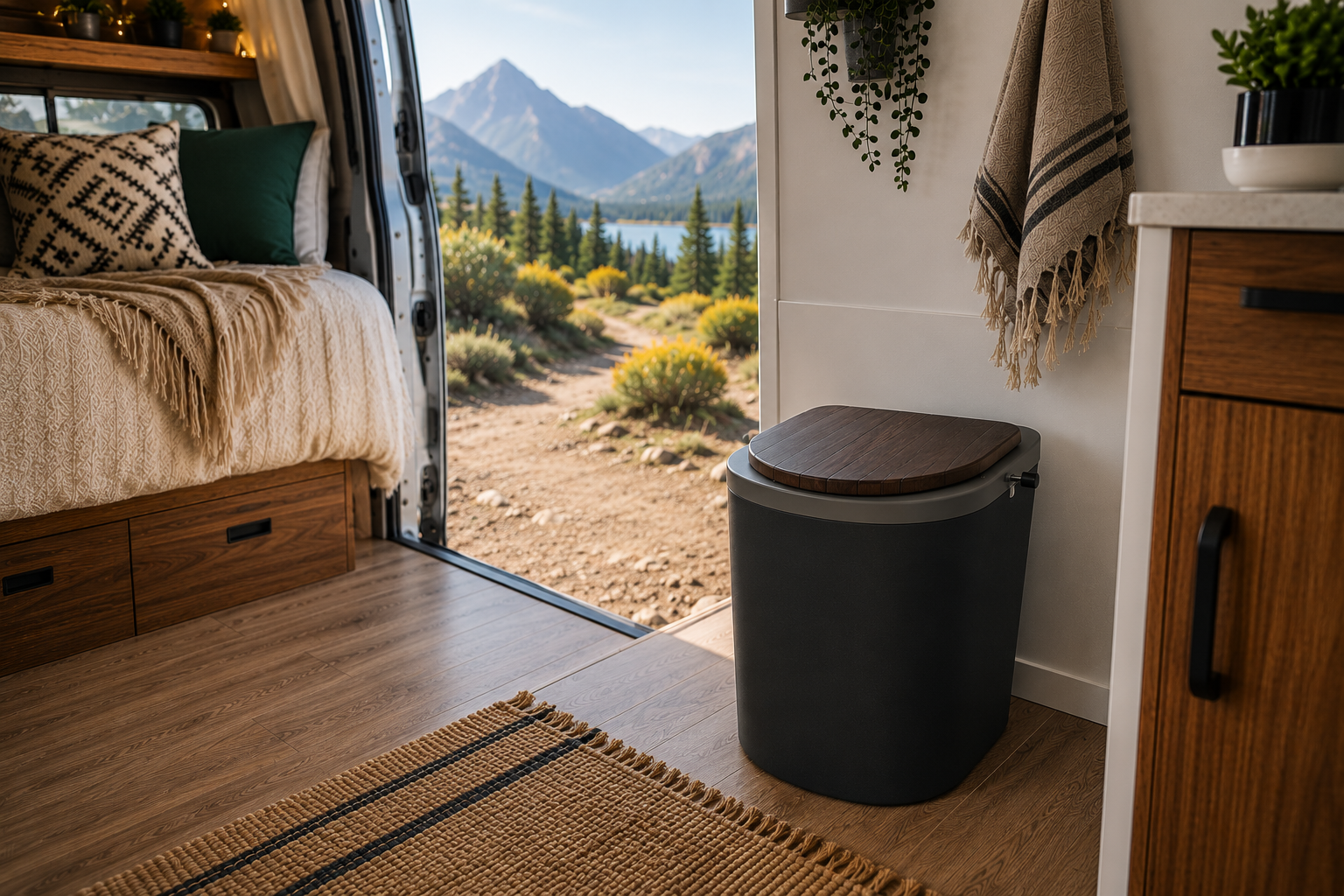
Composting Toilets for Van Life and RVs: What Actually Matters
Van and RV sanitation comes down to a simple question: what system will you actually maintain consistently over weeks and months of travel? The honest answer, for most people who have tried both, is that a composting toilet is significantly easier to live with than a cassette or chemical alternative. Longer between empties, no chemicals, no dump station dependency for solids, and a cleaning routine that takes less than two minutes.
Composting Toilets for Van Life and RVs: What Actually Matters
A composting toilet is one of the best setups for van life and RV travel — not just a workable one. No chemicals to buy, no dump station required for solids, up to a month of capacity before the chamber needs attention, and a system that is genuinely easier to live with than a standard cassette or chemical toilet. When the system is matched to how you actually travel, it becomes one of the lowest-maintenance parts of your build.
The best van bathroom is not the one with the most features. It is the one you will actually use and maintain.
For mobile living, sanitation has to be compact, predictable, and simple. There may be no plumbing hookup, no dump station nearby, and no room for complicated routines. A waterless, mechanical system fits that environment better than almost any alternative — and when you compare it directly to what most van builders start with, the difference is significant.
This post covers what actually matters when choosing and running a composting toilet on the road: capacity planning, ventilation in a tight space, what to carry, and how to handle the real field conditions that van life throws at you.
Why a Composting Toilet Is the Right Choice for Mobile Living
Most van and RV builds start with a chemical cassette toilet — a Porta Potti or similar unit. They are cheap, familiar, and widely available. They are also genuinely unpleasant to own full-time. The cassette tank fills within a few days, requires chemical additives that are increasingly hard to find at smaller stops, and must be emptied at a designated dump station or sanitation point. In the desert, in shoulder season, or off the main routes, that constraint shapes your trip planning in ways that add up fast.
A composting toilet removes those constraints on the solid side of the equation entirely.
Renew capacity: The Renew's composting chamber holds approximately one month of solid waste for a solo traveler or two people traveling together — without emptying. That is ten to fifteen times longer than a standard cassette toilet under the same conditions.
The urine stream is managed separately and requires more frequent attention — typically every three to five days for two people. But the liquid side is much easier to handle: it can be emptied anywhere appropriate (diluted in vegetation away from water sources, or into a toilet at a rest stop or campground). No dump station required.
Composting toilet vs. chemical cassette toilet
-
Solids capacity: Composting toilet ~1 month vs. cassette ~3–5 days
-
Chemicals required: None vs. chemical additive every use
-
Dump station needed: No (solids) / rarely (liquids) vs. every few days
-
Odor in heat: Controlled by separation and ventilation vs. chemical smell that intensifies with heat
-
Ease of cleaning: Wipe-clean bowl, accessible chamber vs. cassette removal and tank rinse
-
Water use: Zero vs. zero (both are waterless in this format)
The Renew is also easy to clean between uses. The bowl is smooth and accessible, the urine diverter wipes down simply, and the chamber lid seals cleanly. There are no tanks to remove, no cassette valves to manage, and no chemical residue to deal with on your hands or in a campground sink.
What Matters in a Mobile Toilet
Most toilet features that matter in a fixed installation matter even more in a mobile one. Space is tighter, conditions vary more, and maintenance access is less convenient. The criteria that actually make or break a van toilet are:
-
Footprint. A composting toilet needs to fit in the space you have — not just in floor area but in height, because most van toilet compartments have limited headroom. The Renew's compact design is built for exactly this constraint.
-
No chemicals. Carrying chemical cassette additives takes up limited storage, they expire, and they are increasingly restricted at dispersed camping locations. A waterless, additive-free system removes that supply dependency entirely.
-
Predictable maintenance schedule. With a one-month solids capacity and a clearly signaled urine container, you can plan around your trip rather than letting the toilet drive your itinerary.
-
Passive odor control. A vent line routed through the van body or roof handles trace odors without drawing on your electrical system. This matters when you are parked off-grid and managing battery reserves.
-
Simple operation. One cover material scoop after each solid use. That is the entire routine. No buttons, no chemicals, no lever valves.
The Renew checks all five. It operates without water, without additives, with passive ventilation, and with a maintenance schedule that is measured in weeks rather than days.
How to Plan Container Capacity
Capacity planning for a van toilet is straightforward once you understand the two streams separately.
Solids — the easy side
The Renew composting chamber holds approximately one month of solid waste for one to two people. For weekend and week-long trips, you will almost never need to think about it. For full-time van life, emptying once a month becomes a simple scheduled task — drop the composted material in a compost pile, a trash bag, or a designated waste point, rinse the chamber, and continue.
Temperature affects the pace of composting but not the functional capacity for storage. In colder months, the biological breakdown slows — but the chamber still holds the same volume and manages odor through the physical separation and cover material, not through active decomposition alone.
Liquids — the side that needs attention
The urine container fills faster and needs more planning. For two people, expect to empty every three to five days in moderate conditions, and every two to three days in desert heat. This is the part of the system that shapes your routine on the road — know where you will empty (rest stops, campground toilets, roadside vegetation away from water), and empty before the container is full rather than waiting until it is urgent.
Virro's Urine Odor Stabilizer extends the window between empties by slowing the breakdown of urea into ammonia — the source of the sharp smell that builds in warm, sealed containers. It is worth carrying on any trip longer than a few days, and especially in summer.
Manage the liquid stream:
Why Ventilation Still Matters in a Van
Every composting toilet relies on airflow to maintain an odor-free environment — and in a van, getting that airflow right is more constrained than in a fixed installation. The vent stack needs to exit the vehicle somewhere, and how you route it determines how well the system performs.
The two common approaches for van installations are through the floor and through the side wall or roof. A floor exit works well in sprinter and transit conversions where there is access to the undercarriage. A wall or roof exit requires a watertight penetration but keeps the vent line shorter and more direct.
Whatever the routing, the key principle is the same as in a fixed installation: air should flow downward through the unit and out, continuously. A passive vent line with a weather-protected exterior cap handles this without any power draw. If the van spends extended time fully sealed and stationary in high heat — parked in direct sun in summer, for example — a small vent fan helps maintain airflow when natural convection slows. But for most travel conditions, passive ventilation is sufficient.
One practical detail specific to vans: check the exterior vent cap regularly for road debris, insects, and spider webs. The vibration and movement of road travel shakes loose material toward any opening. A brief check at each stop takes thirty seconds and prevents the most common cause of unexpected odor on a trip.
Where a Float Sensor Helps
In a van build, the urine container is almost always enclosed — inside a cabinet, under a bench, or in a dedicated toilet compartment. You cannot glance at it the way you might in a larger bathroom. By the time you notice any sign that it is getting full, it is often already past the ideal emptying point.
Virro's Float Sensor monitors the container level and alerts when it is approaching capacity. In a mobile context, this is particularly useful because it gives you actionable notice while you still have options — you are near a rest stop, pulling into camp, or parked somewhere appropriate — rather than discovering the problem when you are already committed to a long stretch of road.
It also removes one mental task from the trip. Van life involves managing a lot of small systems simultaneously. The fewer things that require regular manual checking, the more bandwidth for the actual trip. A float sensor is a small addition that pays for itself quickly in the field.
What to Pack Before a Long Trip
Getting the consumables right before a long trip is the difference between a system that runs smoothly and one that creates problems at inconvenient moments. These are the basics to have on board:
-
Carbon cover material. Enough for every solid use on the trip, plus some buffer. Running low on cover material is the single most common cause of avoidable odor on the road. A sealed container of coconut coir takes minimal space and lasts a long time.
-
Urine Odor Stabilizer. A small bottle covers weeks of use. Add a measured amount to the container after emptying. More important in warm weather and on longer trips where emptying intervals stretch.
-
Disposable gloves. For emptying the urine container and the occasional chamber check. One box takes no space and keeps maintenance clean and quick.
-
A designated emptying bag or container. For the rare occasion when the composted solids need to go into a trash bag rather than a compost site. Sealed, odor-contained, and easy to manage.
-
Exterior vent cap check tool. A small brush or pipe cleaner for clearing the vent cap opening after off-road travel. Optional but worth having on extended backcountry trips.
For full-time van life, these are just stocked and replenished like any other consumable. For weekend and week-long trips, a simple pre-trip check — container emptied, cover material stocked, stabilizer added — sets you up for a trip where the toilet is the last thing you think about.
Shop the van life essentials:
Frequently Asked Questions
Is a composting toilet good for van life?
Yes — it is one of the best options available for van life and RV travel. The main advantages over chemical cassette toilets are the longer solids capacity (approximately one month for the Renew vs. a few days for a cassette), no chemical additives required, no dependency on dump stations for solid waste, and a generally cleaner and more straightforward maintenance experience. The system is compact, runs without water or electricity for core function, and is well-suited to the variable conditions of mobile living.
Can I use a composting toilet while driving?
The toilet is designed for stationary use, as with any toilet. For moving vehicles, it is not intended to be used while in motion. On road trips, the practical approach is the same as with any van toilet: plan stops at intervals that work for your travel pace, and empty the urine container whenever the opportunity arises rather than waiting until it is urgent. The float sensor helps by giving you advance notice while you still have good options.
How do I empty a composting toilet on the road?
The two streams are emptied differently. The urine container is emptied most frequently — at a rest stop toilet, a campground facility, or diluted into vegetation well away from water sources and trails. The composting chamber solids are emptied much less often (approximately once a month for one to two people) and can go into a compost pile, a sealed trash bag for disposal, or at a facility that accepts organic waste. Neither requires a dedicated dump station.
Will a composting toilet smell in a small van?
Not with proper setup and maintenance. The key factors are the same as in any installation: source separation keeps urine and solids apart, ventilation draws air out of the unit continuously, and carbon cover material keeps the composting chamber aerobic. In a van, keeping the urine container emptied before it reaches capacity is especially important in warm weather — the enclosed space amplifies any odor that builds when urine breaks down in a nearly full container. The Urine Odor Stabilizer and float sensor both help manage this reliably.
How does the Renew compare to a cassette toilet for van life?
The practical advantages compound quickly. A cassette toilet fills in three to five days and requires chemical additives and a dump station for each emptying. The Renew holds approximately one month of solid waste, requires no chemicals, and handles the liquid stream independently — which can be emptied almost anywhere. The Renew is also easy to clean: a smooth, accessible bowl, a wipe-clean diverter, and an accessible chamber with no cassette to remove or rinse. For occasional weekend use the difference is manageable. For full-time van life, the operational difference is significant.
Does cold weather affect how a composting toilet works in a van?
Cold temperatures slow biological decomposition, but they do not prevent the system from functioning or controlling odor. The carbon cover and source separation continue to do their job regardless of temperature. The practical effect of cold weather is that the composting process takes longer to break material down — the chamber may fill a little more slowly in terms of volume reduction, but it holds the same quantity and remains odor-controlled throughout. In very cold conditions, the urine container benefits from being emptied more frequently to prevent freezing.
Van and RV sanitation comes down to a simple question: what system will you actually maintain consistently over weeks and months of travel? The honest answer, for most people who have tried both, is that a composting toilet is significantly easier to live with than a cassette or chemical alternative. Longer between empties, no chemicals, no dump station dependency for solids, and a cleaning routine that takes less than two minutes.
The Renew is built for exactly this environment — compact, passive, waterless, and designed to stay out of your way while you focus on the trip.
Build your van setup:
Ready to close the loop?
Explore Virro systems for homes, cabins, vehicles, and places beyond the grid.