

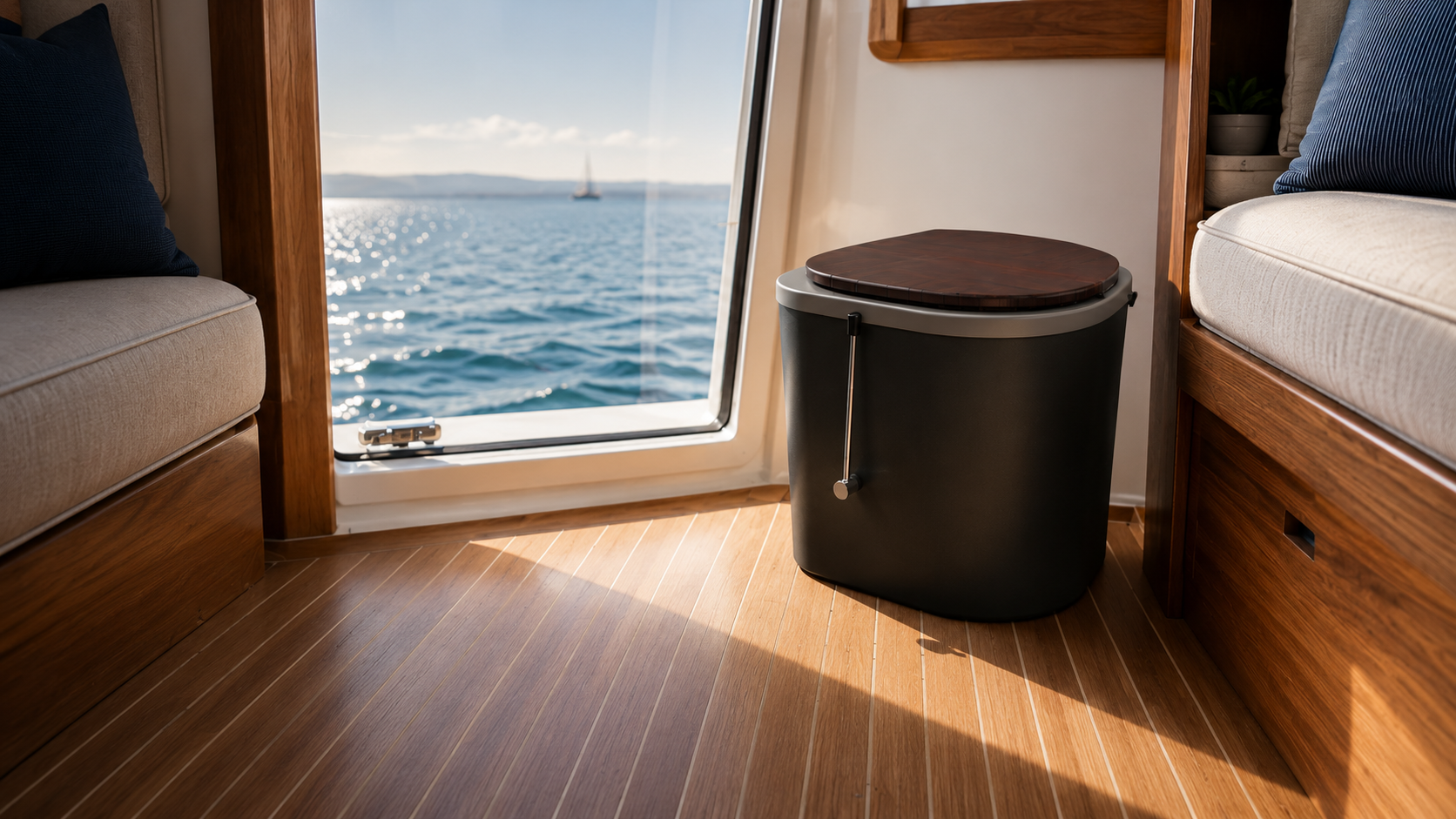
Composting Toilets for Boats, Sailing, and Live-Aboards
The Renew is a compact, mechanically simple, waterless system - that integrates into a 12V DC vessel electrical architecture with negligible load, accommodates both self-contained and tank-connected urine configurations, and operates compliantly in every jurisdiction without modification. For sailors who have spent time managing the alternatives, the engineering is straightforward.
Composting Toilets for Boats, Sailing, and Live-Aboards: The Technical Case
A composting toilet is a Coast Guard-recognized MSD Type III device — it retains all waste on board, discharges nothing overboard, and satisfies federal No Discharge Zone requirements by design. It runs without pressurized water, eliminates macerator pump maintenance and through-hull discharge fittings, and removes the operational dependency on pump-out stations entirely for solid waste. For blue-water sailors, live-aboards, and anyone spending time in NDZs, the engineering case is strong.
Boaters have always been willing to think carefully about waste systems — because the alternatives to getting it right are either a legal problem, a smell problem, or both. The traditional choices each come with significant operational trade-offs: macerators require a through-hull discharge fitting and are prohibited in No Discharge Zones; incinerators draw heavy power and produce ash requiring disposal; pump-out holding tanks are compliant but create a recurring dependency on marina infrastructure that erodes offshore flexibility.
A composting toilet addresses all three constraints simultaneously. This post covers the regulatory classification, the installation configurations available on a vessel, ventilation options including under-hull routing and 12V DC fan integration, and the practical comparison against each of the conventional alternatives.
The MSD Type III Classification — What It Means and Why It Matters
Under 33 CFR Part 159, the U.S. Coast Guard classifies Marine Sanitation Devices in three types based on treatment and discharge behavior. A composting toilet meets the definition of an MSD Type III device: a device that retains sewage on board for subsequent offboard disposal. It does not treat and discharge — it holds, which is the most restrictive and most universally compliant classification available.
Regulatory baseline: An MSD Type III device satisfies requirements in all U.S. waters including No Discharge Zones, where Type I and Type II devices are prohibited from discharging. Type III is the only MSD classification that is universally compliant regardless of jurisdiction.
This matters in practice because the NDZ network in U.S. coastal and inland waters is extensive and expanding. As of 2025, all waters of many states — including New York, Michigan, Vermont, and others — are designated No Discharge Zones. An MSD Type III device requires no modification, no valve configuration check, and no pump-out to maintain legal compliance in any of these waters. The system is compliant by default, at anchor or underway.
For international passages, the picture varies by flag and jurisdiction. MARPOL Annex IV governs vessel sewage discharge offshore, with a general prohibition within 12 nautical miles of land. A composting toilet — retaining all waste — is compliant under any MARPOL interpretation since it produces no overboard discharge.
Practical note: If your vessel carries a composting toilet as its sole MSD, document it as such in your vessel documentation. Some boarding officers are less familiar with composting toilets than with traditional Type III holding tanks. Having the product spec sheet on board clarifies the classification immediately.
How It Compares: Macerators, Incinerators, and Pump-Out Systems
Macerators
A macerator pump grinds waste and discharges it overboard or to a holding tank. Overboard discharge is prohibited within 3 nautical miles of shore (federal law) and in all NDZs regardless of distance — which in practice covers the majority of U.S. coastal and inland cruising grounds. This means a macerator system requires either a parallel holding tank for restricted waters or accepting the compliance risk of operating without one.
Beyond compliance: macerators require a through-hull discharge fitting below the waterline — one additional hole in the hull with its associated seacock, hose, and maintenance schedule. Macerator pumps fail, impellers wear, and blockages in marine environments are not uncommon. The maintenance burden is real.
Incinerating toilets
An incinerating toilet burns waste to ash, eliminating the holding and disposal problem. The engineering is clean in concept. The operational reality for most cruising sailors is more complicated: incineration cycles draw 1,000 to 1,500 watts for 45 to 60 minutes per use, which is a significant load on a 12V house bank without shore power or a generator running. The ash residue requires disposal. And the initial cost is substantially higher than either a holding tank system or a composting toilet.
For marina-based boats with reliable shore power, an incinerating toilet is a functional choice. For offshore passages and anchor-out cruising, the power demand is generally prohibitive without careful energy management.
Pump-out holding tanks
A properly installed holding tank with a deck pump-out fitting is a straightforward, proven MSD Type III solution. The operational constraint is the recurring requirement to locate and use a pump-out station — which costs between five and twenty-five dollars per service at most marinas, more at premium facilities, and may require waiting in queue during peak season at popular anchorages.
For boats that stay close to marina infrastructure, the holding tank is a reasonable choice. For boats that cruise extended coastal passages, spend time in remote anchorages, or leave the marina infrequently, the pump-out dependency becomes a real planning constraint. The composting toilet eliminates that constraint for the solid waste stream entirely.
Direct comparison
-
Through-hull fittings required: Composting toilet — none. Macerator — discharge fitting required. Incinerator — none. Holding tank — pump-out fitting (deck level).
-
NDZ compliance: Composting toilet — compliant by default. Macerator — non-compliant for overboard discharge. Incinerator — compliant (no discharge). Holding tank — compliant if properly sealed.
-
Power draw: Composting toilet — 1–3W (vent fan only, optional). Macerator — 3–6A during pump cycle. Incinerator — 80–125A during cycle. Holding tank — pump draw at service only.
-
Pump-out required: Composting toilet — no (solids ~1 month, liquids as needed). Macerator — frequent (when tank full). Incinerator — no. Holding tank — frequent.
-
Maintenance: Composting toilet — carbon cover, periodic emptying. Macerator — impeller, seals, through-hull. Incinerator — heating elements, ash management. Holding tank — hose inspection, Y-valve, vent.
Installation Configurations: Self-Contained vs. Urine to Tank
The Renew can be installed in two primary configurations aboard a vessel. Which is appropriate depends on available space, the existing plumbing infrastructure, and how long the boat typically spends offshore between port calls.
Configuration 1: Fully self-contained
In a fully self-contained installation, the urine diverter output drains into a removable container stowed beneath or adjacent to the unit. The solids go to the composting chamber. Nothing connects to existing plumbing. This is the simplest installation — the toilet mounts to the sole, the vent line routes to the exterior, and the system is complete. No existing holding tank, no hose connections, no Y-valves.
For vessels with no existing holding tank, for offshore passages where simplicity and redundancy matter, and for retrofits where connecting to existing plumbing is impractical, the self-contained configuration is the right choice. The urine container is emptied overboard offshore (beyond the 3nm limit and outside NDZs), at a pump-out facility, or ashore as appropriate to the current position.
Self-contained note: A float sensor on the urine container is particularly valuable in this configuration, since the container is typically stowed and not visible. An alert when approaching capacity gives you time to plan the next emptying rather than discovering it unexpectedly.
Configuration 2: Urine drained to a holding or dedicated tank
In a configuration with existing plumbing infrastructure, the urine diverter outlet can be plumbed directly to the vessel's holding tank via a small-diameter hose — or to a dedicated small-volume urine tank if the existing holding tank is being removed or bypassed. The solid waste stream remains entirely within the composting chamber, completely isolated from the liquid plumbing.
This configuration is well-suited to vessels with an existing holding tank that will remain in place, to live-aboards who want to minimize manual emptying frequency, and to boats where the head compartment layout makes a separate urine container awkward to access.
When urine is held in a tank rather than emptied frequently, ammonia buildup from urea decomposition becomes more significant — particularly in warm conditions. Virro's Urine Odor Stabilizer added to the tank after each emptying or at regular intervals significantly delays this process, keeping the holding tank odor-neutral between pump-outs. It is the same chemistry that stabilizes an onboard urine container, applied at tank scale.
Manage the liquid side:
Ventilation on a Boat: Options from 12V Fan to Under-Hull Routing
Ventilation for a composting toilet aboard a vessel follows the same principle as in a fixed installation — continuous airflow through the unit and out. The variables specific to a marine environment are the exit point options, the use of powered vs. passive ventilation, and the effect of boat motion on airflow.
Passive ventilation — deck or Dorade
The most straightforward approach routes the vent line through a deck fitting, a Dorade vent cowl, or an existing ventilation port in the head compartment. A Dorade-style vent provides good passive airflow when the boat is sailing or at anchor with a breeze, and can be oriented to capture apparent wind while underway. This works well in most cruising conditions.
Under-hull routing
Some boaters route the vent through the hull below the waterline. At sailing speeds, water flow past the hull opening creates a venturi effect that generates a slight negative pressure — effectively a free, speed-dependent vent fan. This approach requires a properly positioned through-hull fitting (above the waterline at rest, positioned to avoid scooping water at heel) and a seacock for isolation when the boat is stationary. Under-hull venting is passive, requires no power, and benefits from the fact that the boat is moving when it is most needed.
Under-hull installation note: The vent through-hull should be positioned well above the maximum waterline at heel and away from the bow wave. A small check valve prevents backflow when stationary or in reverse. Some builders use a T-fitting to allow both an under-hull exit and an above-deck backup.
12V DC vent fan
A 12V DC vent fan integrated into the vent line provides reliable forced ventilation regardless of vessel speed or wind conditions — at anchor, in a marina, or in a still-air head compartment. Most composting toilet vent fans draw between 1 and 3 watts, which at 12V is under 250mA. On a typical cruising boat's house bank, this is a negligible continuous load — equivalent to a single LED anchor light.
The fan connects directly to the 12V DC house circuit, ideally through a dedicated breaker on the panel. No special wiring is required. For boats with solar or wind charging, a vent fan load is easily absorbed by ambient renewable input without drawing from battery reserves.
For most liveaboard and marina-based installations, a 12V DC fan is the recommended approach — it provides consistent, predictable airflow independent of conditions. For offshore and passage-making contexts where power management is more critical, passive ventilation is entirely adequate when the boat is underway.
What Full-Time Live-Aboards and Offshore Sailors Need to Know
The use cases for a composting toilet on a vessel differ significantly between a marina-based live-aboard and an offshore passage maker. Both benefit from the system, but for different reasons.
Live-aboards
For a live-aboard in a marina or on a mooring, the primary advantages are the elimination of pump-out scheduling and the reduction of holding tank odor — a chronic issue in warm-water marinas where holding tank vents are not always effective. A composting toilet with a urine-to-tank configuration and stabilizer added at each emptying is typically odor-free at the dock in a way that a conventional holding tank system often is not.
The monthly solid waste emptying cycle is also well-suited to a marina-based routine. The chamber can be emptied ashore, composted, or bagged for disposal on a predictable schedule without urgency.
Offshore passage making
For extended offshore passages, the primary advantage shifts to self-sufficiency. A composting toilet carries no pump-out dependency, no macerator pump to fail at sea, no through-hull discharge fitting to develop a weep, and no holding tank full alarm at 0300 mid-passage. The solids capacity of approximately one month means a solo sailor or two-person crew can complete most offshore passages — Atlantic crossings, Pacific legs, coastal passages — without any sanitation-related constraints.
The urine stream in a self-contained configuration does require management. In light-wind or motoring conditions, emptying overboard beyond 3nm is straightforward. In extended heavy weather where going below is difficult, a higher-capacity urine container and stabilizer provide the buffer time to wait for conditions to ease.
One practical consideration specific to offshore sailing: the composting chamber should be checked before departure on a long passage to ensure it is not approaching capacity. A full chamber that cannot be emptied mid-passage is an avoidable problem. Building a pre-departure check into the sea prep list takes thirty seconds.
Outfit your vessel:
Frequently Asked Questions
Is a composting toilet legal on a boat in the United States?
Yes. A composting toilet is classified as an MSD Type III device under 33 CFR Part 159, which means it retains all waste on board and discharges nothing overboard. This is the most compliant MSD classification available — it satisfies requirements in all U.S. waters including No Discharge Zones, where Type I and Type II devices are prohibited from discharging. The vessel must carry a properly functioning MSD; a composting toilet meets that requirement.
Can I eliminate my holding tank if I install a composting toilet?
In most cases, yes. If the composting toilet is the vessel's sole toilet and the urine stream is managed in a self-contained configuration, there is no functional requirement for a separate black water holding tank. Some boaters retain an existing holding tank and plumb the urine diverter output into it; others remove it entirely, reclaiming the space and weight. If your vessel has a Type III holding tank that is currently part of your USCG documentation, consult your documentation before modifying the sanitation system to ensure the paperwork reflects the current configuration.
Does a composting toilet work while the boat is heeling?
Yes, with some practical considerations. The composting chamber and urine diverter function correctly at moderate heel angles typical of coastal and offshore sailing. For extended offshore passages at significant angles of heel, some sailors prefer to have the urine container positioned athwartships rather than fore-aft to avoid sloshing. The solid composting chamber is sealed and not sensitive to heel. As with any head installation, athwartships placement of the unit itself — sitting with your back to the hull — tends to be more comfortable and stable at heel than fore-aft orientation.
How do I manage waste disposal on an offshore passage?
The two streams are managed differently. The urine stream in a self-contained configuration can be emptied overboard when the vessel is beyond 3 nautical miles offshore and outside any No Discharge Zone — the same standard that applies to treated sewage discharge. The composting chamber at approximately one month capacity for one to two people will typically not require attention during a passage of normal duration. On extended passages, if the chamber approaches capacity, the composted material can be sealed in a bag and disposed of ashore at the next port of call.
What is the power draw for a composting toilet on a 12V DC system?
The composting toilet itself requires no power for core function — no electric agitator, no heating element, no pump. The only powered component is an optional vent fan, which draws 1 to 3 watts at 12V (approximately 80 to 250mA). On a 100Ah house bank, this represents less than 0.3% of capacity per hour — a load that is easily absorbed by most charging systems without noticeable impact on energy management. The fan connects directly to the 12V DC house circuit through a standard breaker.
Can the vent be routed through the hull below the waterline?
Yes. Under-hull vent routing is a practical option that uses hull speed to generate passive negative pressure in the vent line — effectively a speed-dependent venturi effect. The through-hull fitting should be positioned above the maximum heeled waterline, fitted with a seacock, and positioned clear of the bow wave and any area likely to ship water. A small check valve prevents backflow when stationary. For boats that are frequently underway, under-hull venting provides effective passive airflow without any power draw.
The technical case for a composting toilet aboard a vessel comes down to three things: universal regulatory compliance without operational dependency, elimination of through-hull discharge infrastructure and its associated maintenance, and a sanitation system that scales with how the boat is actually used — from marina living to offshore passage making — without requiring pump-out access or chemical supply.
The Renew is a compact, mechanically simple, waterless system that integrates into a 12V DC vessel electrical architecture with negligible load, accommodates both self-contained and tank-connected urine configurations, and operates compliantly in every jurisdiction without modification. For sailors who have spent time managing the alternatives, the engineering is straightforward.
Fit out your vessel:
Ready to close the loop?
Explore Virro systems for homes, cabins, vehicles, and places beyond the grid.